
Believe it or not, the E&O industry may be getting one of its most common classes of business, property managers, wrong.
Part of the problem is that the real estate industry has changed dramatically since I began underwriting 20 years ago, while many rating approaches have stayed largely the same.
Historically, many property management firms operated as independent businesses providing services to unrelated property owners. Their revenue was generally a reasonable proxy for the size of their operation and, by extension, their exposure.
Today's real estate organizations often look quite different. Many have evolved into integrated platforms that combine ownership, property management, development, asset management, leasing, acquisition, construction oversight, and investment activities across numerous affiliated entities. A property management company may exist as just one entity within a much larger real estate enterprise.
Yet many E&O submissions still present the property management company as though it is a standalone business, which creates a fundamental problem for underwriters and brokers.
The property management entity may report only a few million dollars of management fee revenue while overseeing thousands of units, managing hundreds of millions of dollars in real estate assets, and servicing properties owned by dozens of affiliated entities. In short, the revenue may be accurate, but the picture of the exposure may not be.
When underwriters rely on reported revenue without considering the properties, services, and named or additional insured entities their policies cover, they can significantly underprice these risks.
When revenue tells the wrong story
Let’s consider two property managers. The first reports $10 million in revenue and manages 5,000 units for unrelated third-party owners. The second reports $2 million in revenue but manages 12,000 units owned by affiliated entities. The organization includes multiple ownership LLCs, development companies, asset management entities, and other related operations.
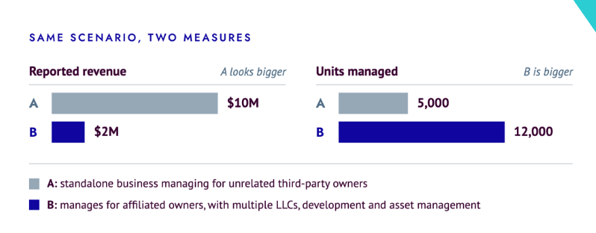
If revenue is the primary rating basis, the first account appears larger. However, the second account may have significantly greater operational complexity, a larger tenant population, higher property values, and more potential for claims.
While revenue tells us what a property manager earns, it does not necessarily tell us what the organization manages, owns, controls, or influences.
In a typical structure, one entity owns the property, another employs staff, and another provides the management services. Yet the revenue of that single management entity often serves as the basis for pricing E&O exposure, which is one reason many property management accounts may be underrated.
What really drives the exposure
Exposure is better understood by looking at several factors together:
- Number of units and properties managed
- Annual rent rolls
- Total property values
- Types of properties managed
- Geographic concentration
- Direct and indirect ownership interests
- Number and purpose of affiliated entities
- Tenant population
- Scope of services provided
Property type is a good example. A company managing affordable housing, large multifamily portfolios, student housing, senior housing, or HOA communities may present a very different exposure from one managing a smaller portfolio of office buildings or industrial properties.
Property management claims frequently arise from allegations involving fair housing, discrimination, habitability, tenant screening, leasing, maintenance oversight, privacy, and property operations. A single process or management decision can affect multiple tenants or an entire portfolio.
Who’s really being insured?
It is common for large real estate organizations to have dozens or even hundreds of LLCs, often with a separate entity for each property. When these entities are listed as additional insureds or included within a broad definition of the insured, the requested coverage may extend well beyond the property management company shown on the application. If they are not contemplated as insureds, the client may face an unpleasant surprise when a claim is made.
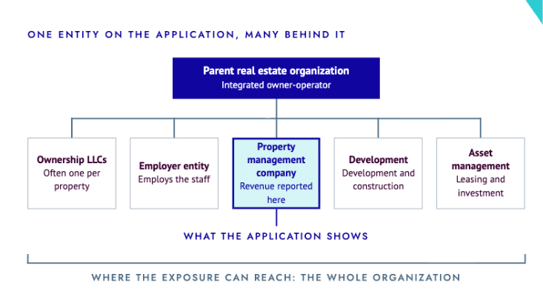
The entity structure should not be treated as an administrative detail. Underwriters need to understand which entity is providing the covered professional services, which entities own the properties, and why each entity needs coverage. An organizational chart and complete entity schedule should be part of the underwriting process when the structure is complex.
This is important for brokers as well. When a submission does not explain the larger organization, the underwriter is left to piece together the exposure through public records, additional insured requests, entity schedules, websites, and follow-up questions. This often results in delays, revised terms, increased retentions, additional underwriting requests, or carriers becoming less comfortable with the risk as more information comes to light.
A strong submission should not rely on a low revenue figure to make a complex organization appear smaller. It should explain why the revenue is low, how the organization is structured, what the property manager actually does, and which entities require coverage.
Brokers who understand this can create better outcomes for their clients. Providing an organizational chart, rent roll, property schedule, ownership information, unit count, total property values, and a clear description of services help the underwriter understand the risk from the outset. More importantly, it helps determine whether reported revenue accurately reflects the operation’s true size and complexity.
Better information does not automatically mean more premium. In fact, it can produce the opposite result, helping an underwriter recognize when a large portfolio is professionally managed, when affiliated entities are properly structured, and when services are limited to traditional property management rather than broader real estate operations.
A better approach
The goal should not be to find the lowest revenue figure, but rather to establish a rating basis that accurately reflects the exposure being insured.
This does not mean every property manager should be priced more aggressively. It means we, as an industry, need to better distinguish between a traditional third-party property manager and the property management arm of a large owner-operator. Those are not necessarily the same exposure and therefore should not automatically receive the same underwriting treatment.
That starts with a more disciplined approach to understanding the organization before pricing the risk. For every property manager account, underwriters and brokers should be asking:
- What does the organization manage, own, and control?
- What is the true scale: units, properties, tenants, annual rent roll, and total property values?
- What percentage of the portfolio is owned by the applicant or its affiliates?
- Which entity is performing the professional services, and which entities expect coverage?
- Are additional services being provided beyond property management?
- Does the structure reflect a traditional property manager or an integrated real estate platform?
- Do the pricing, retention, and coverage terms reflect the actual exposure?
If these questions are left unanswered, we are not fully underwriting the risk; we are pricing an application.
Underwriters should challenge revenue figures that do not align with employee count, unit count, rent rolls, property values, or organizational complexity. Brokers should anticipate those questions and provide the information needed to explain the risk before it becomes an issue.
When the structure is complex, we should also separate the exposure of the entity performing the covered services from ownership, development, construction, investment, and other activities.
The submission process and underwriting method need to evolve with the industry. That means adopting a broader view of exposure, so that pricing reflects how the organization actually operates.
Underwrite the organization, not just the revenue figure.